How can the experience of hospital outpatient departments for Neurofibromatosis (NF) patients with sensory challenges be improved? An Experience Based Co-Design project protocol
Rona Inniss, Associate Professor Evangelia Chrysikou, Dr Emma Rowland, Dr Susie Henley, Dr Sue Woodward.
Poster references
1. House of Commons Library. (2025). UK disability statistics: Prevalence and life experiences. https://commonslibrary.parliament.uk/research-briefings/cbp-9602/
2. NHS Digital. (2025). Hospital Outpatient Activity 2024-25. https://digital.nhs.uk/data-and-information/publications/statistical/hospital-outpatient-activity/2024-25
3. Inniss R, Palityka D, Henley SMD, Chrysikou E, Woodward S. (2026) How is the Built Environment of a Contemporary Outpatient Department Experienced? A Systematic Review of Qualitative Evidence. HERD: Health Environments Research & Design Journal. https://doi.org/10.1177/19375867261474204
Poster
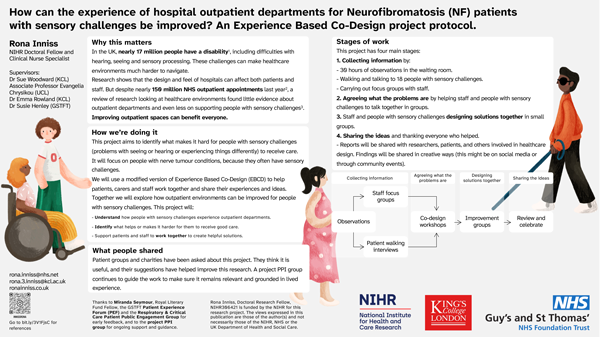
How can the experience of hospital outpatient departments for Neurofibromatosis (NF) patients with sensory challenges be improved? An Experience Based Co-Design project protocol.
Download the poster (pdf 788kb)
Abstract
This project aims to improve outpatient departments (places where people go for check-ups). It focuses on people with sensory challenges. These include problems with seeing or hearing or experiencing things differently. Research has shown that the design and feel of hospitals can affect both patients and staff. This project will help people with sensory challenges and staff to work together to improve outpatient departments. It will focus on people with nerve tumour conditions. This is because they often have sensory challenges.
Why is this important?
In the UK, around 16 million people had a disability in 20217. This includes 9% who had trouble hearing and 9% who had trouble seeing. People with Learning Disabilities and autism (who are more likely to have sensory challenges) often face problems with healthcare environments. A review of research looking at healthcare buildings found a lack of focus on the design of outpatient departments. It found a lack of focus on supporting people with sensory challenges. Improving these spaces can benefit everyone.
What does this research involve?
This project will use Experienced Based Co-design (EBCD). This helps people work together to come up with better ways to do things by sharing their experiences and ideas.
This project aims to show how the experience of outpatient departments can be improved for people with sensory challenges. It aims to improve outpatient departments by:
Understanding how people with sensory challenges experience outpatient departments.
-Identifying what helps or makes it harder for them to receive good care.
-Supporting patients and staff to work together to create helpful solutions.
This research aims to help stop everyday problems. To show whether small changes help, patients and staff will be asked how happy they are with the changes and the service.
Project overview
This project has four main parts:
1. Collecting information by:
-30 hours of observations in the waiting room.
-Walking and talking to 18 people with sensory challenges.
-Carrying out focus groups with staff.
2. Agreeing what the problems are by helping staff and people with sensory challenges to talk together in groups.
3. Staff and people with sensory challenges designing solutions together in small groups.
4. Sharing the ideas and thanking everyone who helped.
Patient groups and charities have been asked about this project. They think it is useful, and their suggestions have helped improve this research. Patients (lay advisors) will help guide the research to make sure it stays helpful and on track.
How will findings be shared?
Reports will be shared with researchers, patients, and others involved in healthcare design. Findings will be shared in creative ways. This might be on social media or through community events.
Thanks to Miranda Seymour, Royal Literary Fund Fellow, and GSTFT Patient Experience Forum for help with this plain English summary.
Support
Rona Inniss, Doctoral Research Fellow, NIHR306421 is funded by the NIHR for this research project. The views expressed in this publication are those of the author(s) and not necessarily those of the NIHR, NHS or the UK Department of Health and Social Care.
Ethical approval for this study was granted by the Health Research Authority (HRA) on 03/09/2026 (IRAS project ID 364737) approved by East Midlands-Leicester South Research Ethics Committee reference 26/EM/0158 on 03/09/2026. The protocol is registered on clinicalTrials.gov (ID NCT07818213).
